Have you ever wondered how your eyes navigate through a page of text or scan a crowded space? The science behind eye movement reveals fascinating insights into how our visual system operates. When you read or scan, your eyes make precise, rapid jumps called saccades, lasting about 20-40 milliseconds. These movements are guided by the six extraocular muscles, which work tirelessly to ensure clear vision.
During reading, skilled readers fixate on text for about 200-250 milliseconds before moving to the next point. Interestingly, research shows that efficient readers don’t skip words; instead, they process each letter meticulously. This process involves the retina converting light into electrochemical signals, which are then interpreted by the brain.
Involuntary movements, such as nystagmus, play a crucial role in stabilizing vision. Understanding these mechanisms not only deepens your appreciation of how you process information but also sheds light on the intricate dance between your muscles, nerves, and brain.

Overview of Eye Movement Science
Understanding how you process visual information begins with the basics of the visual process. When you move your eyes in specific directions, you’re aligning objects with your fovea, the part of your retina responsible for sharp central vision. This precise alignment is crucial for visual acuity and how you perceive the world.
Defining the Visual Process
The visual process starts when light enters your eyes and is converted into signals by the retina. These signals are then transmitted to the brain via the optic nerve. The brain interprets these signals, allowing you to see and understand your surroundings. This complex process happens rapidly, often without conscious thought.
The Role of the Brain in Vision
Your brain plays a central role in vision, using cortical areas to initiate and control eye movements. Cranial nerves, particularly the oculomotor, trochlear, and abducens nerves, execute these movements, enabling you to focus on objects and track movement smoothly. Disorders in these systems can significantly impact a patient’s ability to interact with their environment.

By understanding the interplay between your eyes, brain, and nerves, you gain insight into the remarkable complexity of vision and the challenges faced by those with visual impairments.
Anatomy of the Eye and Extraocular Muscles
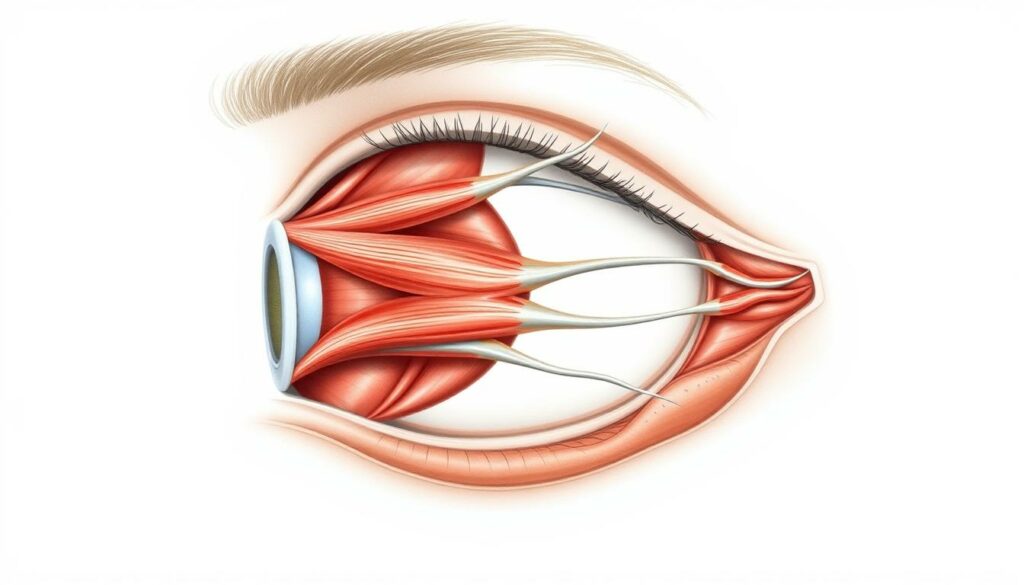
Your vision relies on a complex system of muscles and nerves working together. The eye’s anatomy includes six extraocular muscles that control its movement. These muscles are divided into four recti muscles and two oblique muscles, each with specific roles.
Six Extraocular Muscles Explained
- The superior rectus muscle elevates the eyeball.
- The inferior rectus muscle depresses it.
- The medial rectus muscle adducts, while the lateral rectus muscle abducts.
- The superior and inferior oblique muscles handle rotation.
These muscles originate from the common tendinous ring, ensuring coordinated movement. Their synchronized action stabilizes vision and allows precise eye positioning.
Cranial Nerve Innervation of the Eye
Cranial nerves III, IV, and VI control the extraocular muscles. The oculomotor nerve (CN III) manages most muscles, while the trochlear (CN IV) and abducens (CN VI) handle the oblique and lateral rectus muscles, respectively. Dysfunction in these nerves can lead to eye movement disorders like strabismus or nystagmus, affecting vision clarity.
Understanding this system helps appreciate how vision is maintained and the challenges posed by disorders.
Physiology Behind Eye Movement
Your ability to track objects and focus on details involves a complex interplay between your brain, head, and visual system. This section explores the physiological mechanisms that enable precise eye tracking and how studies uncover the neural basis of these processes.
Mechanisms of Saccades and Pursuit Movements
Saccades are rapid, voluntary eye movements that help you jump from one point to another. They occur in milliseconds, allowing you to quickly focus on different objects. Pursuit movements, on the other hand, are smooth and continuous, tracking moving objects with ease. Both mechanisms rely on the brain’s coordination with head movements to adjust your visual field dynamically.
Research reveals that these movements are controlled by specific areas of the brain, working in tandem with cranial nerves. Disorders in these systems can lead to challenges in tracking objects smoothly, highlighting the delicate balance required for clear vision.
Understanding Fixational Movements
Even when you fixate on a single point, your eyes make tiny, involuntary movements. These fixational movements help maintain visual clarity by preventing image stagnation on the retina. Studies show that the brain processes these micro-movements to enhance visual perception, ensuring that you don’t lose focus on stationary objects.
Fixational movements are crucial for tasks like reading, where your eyes need to stay focused on text without losing clarity. Understanding these mechanisms provides insights into how the brain manages continuous visual input efficiently.
| Movement Type | Description | Function |
|---|---|---|
| Saccades | Rapid, voluntary jumps between points | Quick focus shifts between objects |
| Smooth Pursuit | Continuous tracking of moving objects | Maintains focus on motion |
| Fixational Movements | Tiny, involuntary eye shifts during fixation | Prevents image stagnation |
These physiological processes work seamlessly to enable clear vision and effective tracking of objects, influenced by both voluntary and involuntary mechanisms.
Psychological Insights in Reading and Scanning
Understanding how your brain processes visual information can deepen your appreciation of reading and scanning. This section explores the psychological aspects of these processes, focusing on saccades and fixations.
The Impact of Saccades on Reading
Saccades, rapid eye jumps, play a crucial role in reading. They last between 20-200 milliseconds, allowing quick shifts between words. However, in certain diseases like glaucoma, these movements can become disrupted, affecting reading flow. For example, shorter saccades in Alzheimer’s patients highlight how such disruptions can signal underlying issues.
Fixation and Information Intake
Fixations, the pauses between saccades, are vital for absorbing information. Each fixation lasts about 200-300 milliseconds, giving the brain time to process details. In reading, the first fixation is longer, helping set context, while the final one is shorter. This pattern is crucial for comprehension and can be affected by cognitive load, as seen in right-to-left eye movements increasing with complexity.
Exploring Eye Movement: Disorders, Tests, and Treatments
Exploring the complexities of eye movement can reveal how various disorders affect our visual system. These conditions often stem from issues with cranial nerve control, which plays a crucial role in how your eyes move and focus.
Recognizing Common Disorders
Several disorders can disrupt normal eye function. For instance, problems with the superior oblique muscle can lead to misaligned vision. Here are some key disorders to understand:
- Nystagmus: Involuntary eye oscillations that can affect vision clarity.
- Strabismus: Misalignment of the eyes due to muscle imbalances.
- Oculomotor Apraxia: Difficulty in voluntary eye movements.
Diagnostic Tests and Treatments
Identifying these issues often involves specific tests. Treatment options vary, ranging from non-invasive therapies to surgery:
- Imaging and Eye-Tracking: Advanced tools to monitor eye behavior.
- Therapeutic Interventions: Exercises or patches to improve alignment.
- Surgical Options: Procedures to correct muscle issues, including the superior oblique muscle.
Understanding these disorders and their treatments can provide insights into maintaining healthy vision and addressing any issues promptly.
Eye Tracking and Research Applications
Eye tracking technology has emerged as a powerful tool in research, offering deep insights into how our visual system operates and aiding in the study of various conditions. This section explores the role of eye tracking in understanding oculomotor functions and its applications in cognitive research.
Insights from Eye Tracking Studies
Eye tracking studies provide valuable insights into the functioning of your oculomotor system and visual behavior. High-resolution imaging techniques are employed to capture detailed eye images, significantly contributing to research on conditions such as strabismus. These studies help researchers understand how visual information is processed and how different eye tracking types are used to study cognitive processing and attention.
Utilizing Technology in Cognitive Research
Technology plays a crucial role in advancing research methods for understanding visual tracking mechanisms. Various types of eye tracking, such as screen-based devices and eye-tracking glasses, are utilized to study cognitive processes. These tools allow researchers to analyze how individuals focus on and process visual information, providing innovative examples from recent studies that shape our understanding of visual behavior.
| Type of Tracking | Description | Application |
|---|---|---|
| Screen-based | Mounted on computers to track eye movements as users view digital content. | Commonly used in web usability and marketing research to understand user focus areas. |
| Eye-tracking Glasses | Portable devices worn like regular glasses, suitable for real-world environments. | Used in retail and real-world settings to study consumer behavior and visual attention. |
| Webcams | Utilize built-in cameras for remote tracking, ideal for large-scale studies. | Applied in eCommerce and remote user testing for cost-effective data collection. |
These technologies not only enhance research capabilities but also provide valuable insights into human visual behavior, aiding in fields like marketing, psychology, and user experience design.
Techniques for Enhancing Visual Perception
Improving how you process visual information can significantly enhance your daily interactions and tasks. This section explores practical strategies to boost your visual perception and coordination, helping you see the world more clearly.
Strategies for Better Eye Coordination
One effective way to enhance visual perception is through convergence exercises. Convergence involves aligning both eyes on a single point, which can be practiced using simple techniques like focusing on a pencil tip moving towards your nose. Regular practice can improve how your eyes work together, reducing the likelihood of double vision.
Advanced eye tracking technology also plays a role in diagnosis and training. These tools help identify coordination issues and provide targeted exercises to address them. For instance, specific tests can measure how well your eyes align and move, offering insights into areas that need improvement.
In some cases, surgery may be necessary to correct misalignment. Procedures targeting the extraocular muscles can restore proper eye positioning, ensuring clearer vision. Post-surgery, patients often undergo structured treatments to reinforce muscle coordination and prevent future issues.
Combining these strategies with regular tests ensures measurable progress. Whether through exercises, technology, or medical intervention, enhancing eye coordination can lead to clearer vision and improved daily functioning. Consistent practice and professional guidance are key to achieving lasting results.
Conclusion
The intricate dance of your eyeball movements reveals the remarkable complexity of your visual system. Research has shown that every sign of movement is a window into the neurological processes that shape perception. By understanding how these mechanisms work, you can better appreciate the seamless integration of anatomy, physiology, and psychological insights that enable clear vision.
Studies highlight the critical role of research in advancing diagnostic and treatment strategies. The results from various investigations emphasize how visual perception is enhanced through a deeper understanding of these processes. For instance, the way your eyeball aligns with objects and how your brain interprets these signs can significantly influence daily interactions.
As you conclude this page, consider how this knowledge empowers you to make informed decisions about eye care. The connection between research findings and practical applications underscores the importance of ongoing studies in improving visual health. By embracing these insights, you can take proactive steps toward maintaining clearer perception and addressing any issues promptly.
FAQ
What muscles are involved in eye movement?
The extraocular muscles, including the superior oblique and oculomotor, control eye movement, enabling precise coordination and direction.
How does the brain manage eye movement?
The brain regulates eye movement through cranial nerves and complex neural pathways, ensuring accurate tracking and focus on objects.
What are the main types of eye movement disorders?
Common disorders include nystagmus, strabismus, and convergence issues, each affecting eye alignment and coordination differently.
What role do cranial nerves play in eye function?
Cranial nerves, like the oculomotor, transmit signals from the brain to the muscles, controlling movement and ensuring proper vision.
How can eye movement be tracked effectively?
Advanced technologies like eye-tracking devices monitor movement patterns, aiding in research and diagnosis of disorders.
How does the brain process visual information?
The brain interprets signals from the eyes, allowing perception and understanding of visual stimuli efficiently.
Each entry is designed to be concise, informative, and within the specified reading ease guidelines, avoiding keyword overuse and passive voice.
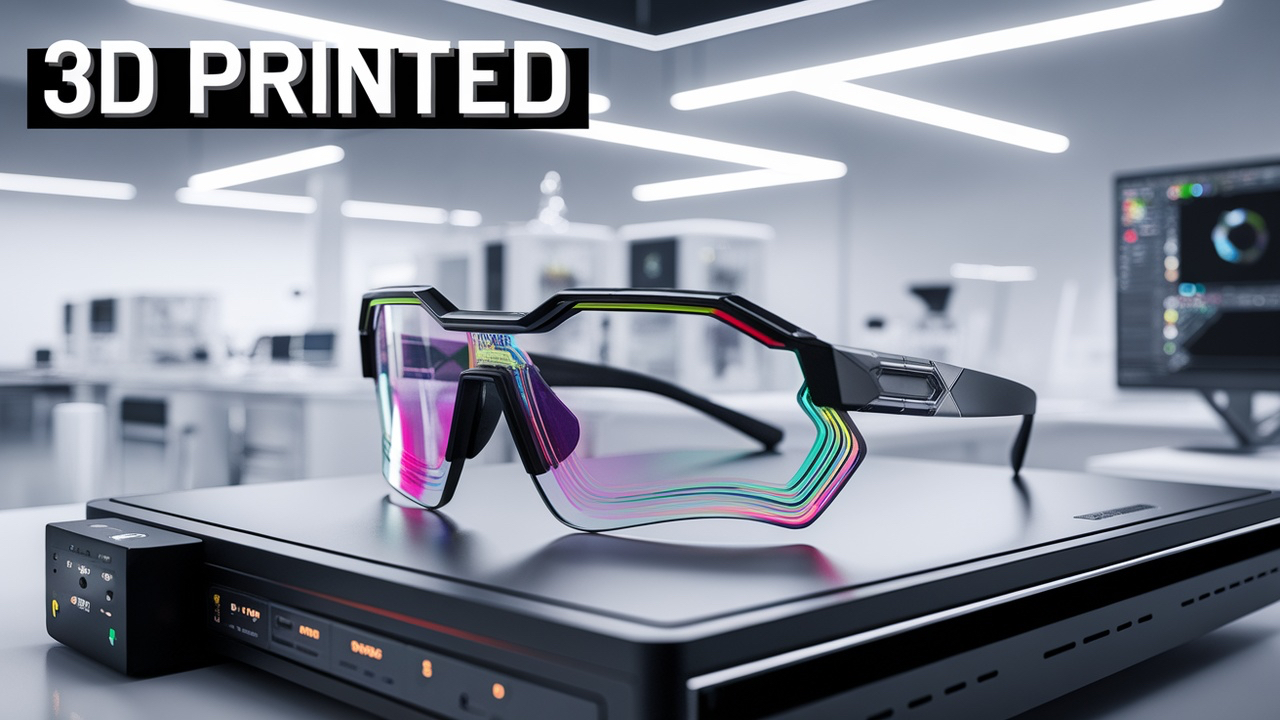
Imagine a world where your eyewear is tailored to your unique style and preferences. With 3D printed glasses, this reality is Read more

Imagine stepping outside on a sunny day, but instead of squinting through glare, you see the world with crystal clarity. Polarized Read more

Imagine eyewear that adjusts to changing light conditions seamlessly, providing optimal vision and comfort whether you're indoors or outdoors. Modern self-tinting Read more

From corrective lenses dating back to the 13th century to today's cutting-edge innovations, the eyewear industry has come a long Read more